In short, the steps are:
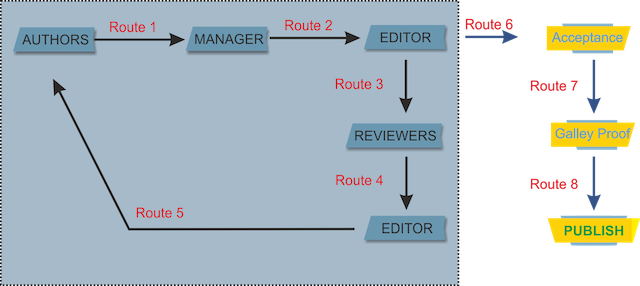
- Manuscript Submission (by author) (route 1)
- Manuscript Check and Selection (by manager and editors) (route 2). Editors have the right to directly accept, reject, or review. Prior to further processing steps, a plagiarism check using Turnitin is applied to each manuscript.
- Manuscript Reviewing Process (by reviewers) (route 3-4)
- Notification of Manuscript Acceptance, Revision, or Rejection (by editor to author based on reviewers' comments) (route 5)
- Paper Revision (by author)
- Revision Submission based on Reviewer Suggestion (by author) with a similar flow to point number 1. (route 1)
- If the reviewer seems to be satisfied with the revision, notification for acceptance (by the editor). (route 6)
- Galley proof and publishing process (routes 7 and 8)
The steps numbered 1 to 5 are considered as 1 round of the peer-reviewing process (see the grey area in the figure). The editor or editorial board considers the feedback provided by the peer reviewers and arrives at a decision. The following are the most common decisions:
- Accepted, as it is. The journal will publish the paper in its original form;
- Accepted by Minor Revisions, the journal will publish the paper and asks the author to make small corrections (let the authors revise within a stipulated time);
- Accepted by Major Revisions, the journal will publish the paper provided the authors make the changes suggested by the reviewers and/or editors (let authors revise within the stipulated time);
- Resubmit (conditional rejection), the journal is willing to reconsider the paper in another round of decision-making after the authors make major changes;
- Rejected (outright rejection), the journal will not publish the paper or reconsider it, even if the authors make major revisions.